Monday, November 28, 2011


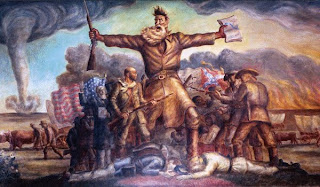
John Brown's body lies a-mouldering in the grave...

Thus begins one of the most influential songs of the 19th-century, sung by Union soldiers marching off to war as "foot-soldiers of the Almighty."

But just who was John Brown?

This week, you'll find out.

Upcoming Assignments

1.) Watch Monterey Institute, Unit 4, Chapter 11, Lesson 34 - "The Approaching War"

a.) "Consider This - John Brown": How did Julia Ward Howe's song with the apocalyptic message influence religious thinking in the North and the South during the Civil War era?

b.) "The United States had been rapidly expanding westward since the Louisiana Purchase. How did American expansion influence a growing sectional crisis after 1820? Did the war with Mexico put the U.S. on an inevitable road toward the Civil War?"

-These two items are due on Wed., 11/30, at the beginning of class.

2.) John Brown - Historical Marker (Due Mon., 12/5)

-John Brown is one of the most polarizing figures in American History...but how should he be remembered? You have been hired by the West Virginia Historical Society to design a historical marker to designate Harpers Ferry as a National Historic Site. Does it show John Brown as a hero and a martyr for the abolitionist cause, or as a deranged lunatic that plunged the nation into a four-year bloody civil war?

Details to be discussed in class.


3.) Zinn, Ch. 9 - on my website. Give yourself enough time...it's very involved.

Due on Mon., 12/5


4.) Ch. 18-19 Study Guides - on my website.

Due Tues., 12/6

Sunday, November 13, 2011

Manifest Destiny, and what to do with all this new land...


This is what Mexico USED to look like, before the Mexican-American War in the 1840s. This war was just one episode, albeit a major one, in America's development into a country that stretched "from sea to shining sea."


This week, we'll take a look at America's growing pains in the 1800s. From an infant nation hugging the eastern seaboard of North America to a voracious teenage country hungry for even more territory, the United States grew exponentially in the mid-19th century. Here's what you'll need to turn in this week:

1.) Watch all Monterey Institute Unit 4, Chapter 11, Lessons 32-33 presentations.

2.) Complete all "Consider This" short-response questions for the above-mentioned Lessons. (Due Thursday, 11/17)

a.) Lesson 32 - John O'Sullivan Editorial
b.) Lesson 32 - The Mexican-American War
c.) Lesson 32 - Walter Colton Diary
d.) Lesson 33 - Henry "Box' Brown
e.) Lesson 33 - THe Ostend Manifesto

3.) Answer the following free-response question as a comment on this blog (this question appeared on the 2000 APUSH exam) by Friday, 11/18:

"Assess the moral arguments and political actions of those OPPOSED to the spread of slavery in the context of TWO of the following:

*Missouri Compromise of 1820
*Mexican-American War
*Compromise of 1850
*Kansas-Nebraska Act"

4.) "American Pageant" Ch. 17 Guidebook - Due Wed., 11/16

5.) Zinn, "A People's History of the U.S." Chapter 8 Questions - Due Wed., 11/16

6.) Read Henry David Thoreau's "Civil Disobedience" (on my webpage); this was Thoreau's treatise on an American citizen's obligation to protest his government's wrongful actions, and an explanation on his willingness to be imprisoned because of his refual to pay a tax in support of the Mexican-American War. As you read it, answer the following questions with well-thought-out responses (Due Fri., 11/18):

a.) Thoreau believes that people should not participate in injustice but that they do not have to actively promote a more just world. What is the difference between these two concepts, and why does Thoreau make this moral distinction?

b.) Is Thoreau's conception of civil disobedience compatible with democratic government? Why or why not?

c.) What is Thoreau's opinion on wealth and consumption? Why does he say that the rich are less likely to practice civil disobedience?

d.) What might Thoreau think about the role of government in today's society (in particular, what might he think about the modern welfare state?)?

e.) Is compromise on moral issues a necessary part of living with other people?

f.) How does Thoreau justify the moral need for civil disobedience? What principles does he rely on in his justification?

g.) Would you describe Thoreau as optimistic or pessimistic about people's ability to improve the world? Explain.


*Though I will not require it over the Thanksgiving break, you may wish to take a "preview" look at the upcoming chapters in "American Pageant" and Monterey Institute's website if you wish to be successful on the next exam. The "American Pageant" guidebooks for Chapters 18-21 are already on my website, and you KNOW what will be required from the Monterey Institute website for the next few chapters. We will move VERY fast after Thanksgiving in order to be through the Civil War by the winter holidays. The workload won't lessen, though...

Monday, October 31, 2011

The Ferment of Reform & Culture, 1790-1860


Yeah, about that...

The picture to your left is nothing new, though. People have been predicting the end times for centuries, and U.S. history is full of such instances. In this next section of APUSH, we will explore the beginnings of the Second Great Awakening in America's young experience and compare it to the first Great Awakening a century before. We will also see how higher-minded people set out to reform this nation in the wake of the religious fervor and cultural shift in the 1830s and 1840s. As you study for your next exam (coming next week over "American Pageant", Chapters 12-16), keep in mind how the reform movement grew in this time period, the role women took in the early American reform movement, and advances in public education and the sciences.

Stuff due soon:

1.) Guiding Questions and Graphic Organizer for "Irish Immigration" classroom lesson on Tues., 11/1.

2.) "American Pageant" Chapter 14 & 15 Guidebooks due by Wed., 11/2.

3.) "American Pageant" Chapter 14 & 15 Short-Response Questions (on my webpage) due on Fri., 11/4.

4.) Monterey Institute Unit 3, Chapter 10 Activities due Monday, 11/7. These include:

A.) Lesson 30: "Transcendentalism" - Consider This: "Do you think it would be possible to be as happy living in Thoreau's cabin as in emerson's elegant house?" Be sure while answering this that you show a basic understanding of transcendentalism.

B.) Lesson 30: "The Second Great Awakening" - Consider This: "Though men such as Charles Finney & Peter cartwright were leaders of religious revivalism i nthe early 19th century, notice the strong presence of women in the revival and camp meeting scenes. What ideas do you think the artists meant to express by giving women so consistently a dominant place of interest?"

C.) Lesson 30: "Millerites" - Consider This: "End-of-the-world predictions play on human anxieties and are a regular feature of history, especially at the turns of centuries. How do the preparations of the man depicted in this cartoon compare with those that many people made at the turn of the millenium in expectation of a Y2K disaster?"

D.) Lesson 30: "Alternative Communities" - Consider This: "Communal groups can be very efficient and productive when sincere and like-minded adherents are led by powerful idealists, as in the Shaker and Mormon communities. Why do you think such groups either faded away or altered their system to a more mainstream standard after a relatively short length of time?"

E.) Lesson 31: "David Walker's Appeal" - Consider This: "Did the actions of abolition extremists, like David Walker, help or hurt the antislavery crusade?" Be sure to include several pieces of evidence to back up your opinion.

F.) Chapter 10 Writing Assignment: "Great Awakening/Second Great Awakening" Comparison (be sure to use the Graphic Organizer in compiling evidence to form a coherent thesis AND write an essay).

G.) Chapter 10 Discussion Question: "How did the Second Great Awakening influence the reform movements of the nineteenth century? How did these reform movements socially re-shape the United States and allow for growing sectionalism?"

-Monterey Institute Assignments for Unit 3, Chapter 10, are due by Tues., 11/8.

Wednesday, October 12, 2011

Andrew Jackson & The Rise of Mass Democracy


Look at the picture to the side: what does it represent to you?

This is a depiction of newly-elected President Andrew "Old Hickory" Jackson's inaugural party at the White House in 1829. The nation's capital had never seen such an event: thousands of people gathered in Washington, DC, to celebrate Andy's victory because, after all, they had received an invitation from the "People's Champion" himself! Most of them finally converged at the White House, compelling Jackson to sneak out the back door while his constituency offended their fellow more elitist party-goers, broke (or stole) the White House china and silverware, and consumed vast amounts of celebratory cider and punch. It was obvious to all observors that politics, and America itself, had changed...if not for the better, than at least for good. After all, as Jackson's detractors would sneer, would you ever see President Washington or John Adams presiding over such a scene?

For the next several days, we're going to take a look at how American politics changed as a result of the War of 1812 (otherwise known as the Second War for American Independence) and the rise of the Jacksonians. Also key to this study will be the impact of the United States' early westward expansion on the native Americans that lived on the American frontier. Your assignments for the next several days will be:

1.) Watch the presentations for Monterey Institute, Unit 3, Ch. 7-8, Lessons 20-22

a.) Lesson 20 - "The Louisiana Purchase" - Consider This - Were President Jefferson's responses to the Barbary pirates and the opportunity to buy the Louisiana Territory in harmony or conflict with his philosophy of Jeffersonian democracy?
b.) Lesson 20 - "The Aaron Burr Conspiracy" - Consider This - How did Aaron Burr's fateful duel with Alexander Hamilton affect political strategies of the early 1800s? What did Burr lose and/or gain politically?
c.) Lesson 21 - "Jefferson's Embargo" - Consider This - How did the Embargo & Non-Intercourse Acts support or challenge President Jefferson's political beliefs?

-These questions and answers are due on Mon., 10/17.

2.) Watch the presentations for Monterey Institute, Unit 3, Chapter 9, Lessons 26-29

a.) Lesson 26 - "The Election of 1828" - Consider This - The states of Virginia and Maryland were the last to adopt universal manhood suffrage. What characteristics do you think caused them to wait?
b.) Lesson 27 - "The Tariff of 1828" - Consider This - What other actions did President Jackson take that his opponents considered were outside of the authority of the presidency?
c.) Lesson 28 - "19th Century Banking" - Consider This - If the charter for the 2nd Bank of the United States had been renewed, how do you think it would have influenced the development of the West?
d.) Lesson 29 - "The Indian Removal Act" - Consider This - If Jackson had NOT been successful in carrying out his plan of Indian Removal, do you think the eastern states would have remained ethnically multiracial instead of biracial? What implications might that have had during the Civil War era?

-These questions and answers are due on Tues., 10/18.

3.) "American Pageant" Guidebooks, Ch. 12-13 - Due by Wed., 10/19

4.) "American Pageant", Ch. 12-13 Short-Response Questions (on my McKeel webpage) - don't wait until the last minute!! There are 48...

-Due Thurs., 10/20

4.) Zinn's "People's History", Ch. 7 - "As Long As the Grass Grows and the Water Runs"

a.) In 3-to-5 paragraphs, briefly summarize the chapter. Be sure to include the following words/terms, and highlight where you use them: Indian Removal, Tecumseh, Andrew Jackson, Creeks, Cherokee, Sam Worcester, Assimilation
b.) Answer the following:
1.) Explain why the United States treated natives in the manner they did. (3 to 5 paragraphs)
2.) Is there any parallel between Bacon’s Rebellion and the Indian wars preceding the War of 1812, with respect to the dynamics among the Indians, poor whites, and rich whites? If so, explain how the situations are parallel. If not, what factors are different enough so that there is no structural parallel? (3 to 4 paragraphs)

-Due Friday, 10/21

Sunday, September 25, 2011

The Constitution

What makes the United States special? Is it our diversity? Our determination? Our natural resources? Or is it our system of government, a system of checks and balances on the most powerful governing parts, set up in a way as to not allow any one part more obvious power over the other two? A system that is run, for all intents and purposes, by the voices of those that it governs?

This week, we will take a closer look at this system and its formation in the late 1700s, a decade after independence from Britain was won. You are responsible for the following assignments.

[Please remember, at this point, you are full-fledged APUSH students, so this will now be run more like a college class; in other words, no more late assignments will be accepted. Assignments are due during 2nd period on the due dates unless otherwise noted. If you have a question or concern about this policy, see me during my office hours (8:30-9:20AM daily, or afternoons by appointment).]


1.)“American Pageant” Guidebooks, Ch. 9 & 10 – Due Tues., 9/27

2.)Document-Based Question :“How Revolutionary Was the Revolutionary War?” – Due Wed., 9/28

3.)Precis for Zinn, Ch. 5 – Due Thursday, 9/29

4.)Monterey Institute, Unit 2 – Chapter 5 (Lessons 14 & 15) – Due Fri., 9/30
a.)Lesson 14 – “Explore the Articles of Confederation” – Mult. Choice
b.)Lesson 14 – “Explore the Virginia Statute of Religious Freedom, 1786” – Answer the “Consider This” question
c.)Lesson 15 – “Explore ‘A Supernumerary Crisis’ by Thomas Paine” – Mult. Choice
d.)Lesson 15 – “Explore the Land Ordinance of 1785” – Mult. Choice
e.)Lesson 15 – “Explore the Northwest Ordinance of 1787” – Mult. Choice
f.)Lesson 15 – “Explore Letters to James Madison” – Answer the “Consider This” question

5.)“The Framers and the Faithful” article from “Washington Monthly”, April 2006 – Read the article, and answer the questions included (BOTH documents are on my McKeel webpage) – Due Mon., 10/3

6.)Zinn, Ch. 6 – “The Intimately Oppressed” (Questions on my webpage) – Due Tues., 10/4

7.)Monterey Institute, Unit 2, Chapter 6 (Lessons 16 thru 19) – Due Thurs., 10/6
a.)Chapter 6 – Free-Response Question (“Evaluate the extent to which the Articles of Confederation were effective in solving the problems that confronted the new nation?”
b.)Chapter 6 Writing Assignment (“Patrick Henry’s objection”)
c.)Chapter 6 Discussion Question (“How did the compromises made when writing and ratifying the Constitution encourage the development of political factions? Compare and Contrast the effectiveness of Washington’s and Adams’ presidencies in obeying and promoting the Constitution during their administrations.”)
d.)Lesson 16 – “Explore Congress Hall, Philadelphia” – Answer the “Consider This” question
e.)Lesson 17 – “Explore Federalist & Anti-Federalist Papers on Taxation Power” – Mult. Choice
f.)Lesson 17 – “Explore Washington’s First Inaugural Address” – Mult. Choice
g.)Lesson 17 – “Explore Bill of Rights” – Mult. Choice
h.)Lesson 18 – “Explore George Washington’s Proclamation of Neutrality” – Mult. Choice
i.)Lesson 18 – “Explore the Jay Treaty” – Mult. Choice
j.)Lesson 18 – “Explore Washington’s Farewell Address” – Mult. Choice
k.)Lesson 19 – “Explore Virginia & Kentucky Resolutions” – Mult. Choice

Besides these assignments, you will also have classwork assignments that will be turned in as well.

Wednesday, September 7, 2011

Founding Fathers, or Revolutionary Outlaws?


So, just what exactly is this thing called "HISTORY"?

-It's an account of the past.
-The accounts/narratives differ depending on one’s perspective.
-As historians, we rely on evidence to construct our accounts of the past.

-Any single piece of evidence is insufficient...therefore, we must consult multiple pieces of evidence in order to build a plausible account.

What would you say about a person that formed an opinion about a topic after only viewing one source of information? Can you then build an historical account based on only one side of the story?

Take the Founding Fathers, for instance. They risked EVERYTHING they had earned and/or inherited, legally and illegally, to form a more perfect union out of 13 English colonies hugging the eastern seaboard of the North American continent (if you want to know what sort of danger the Founders were in during the struggle, check out the account in "American Pageant" of how King George III dealt with a few Irish rebels at the same time). But why? Out of a sense of duty to create something better for posterity? Because Parliament and King George III taxed them too heavily? Are there other reasons?

We all know how the American Revolution ended...and we all know that the winners write history. Have you ever checked out the English side of the story, though?


http://www.redcoat.me.uk/Rev-War.htm

I think you'll agree that there account of the facts is a little bit different than ours.

Here is a list of what's coming up:

1.) "American Pageant," Ch. 8 Guidebook - due by Mon., 9/12

2.) "Loyalists" - some colonists remained loyal to England during the fight for independence (like colonists in East & West Florida, the 14th & 15th colonies that never get mentioned). Why? At what cost? On my McKeel webpage, there are a series of primary documents in .PDF format titled "Loyalists"; read the accounts and complete the graphic organizer attached. Then answer in paragraph-form the following (using your knowledge of the topic):

• Why did some colonists oppose independence?
• Do their arguments seem reasonable?
• What might Patriots have said in response to these arguments?
• Which side do you think was more reasonable?

*This "Loyalists" assignment is due on Tues., 9/13.

3.) You will need to view the following lessons (and complete the activities) on the Monterey Institute's AP US History I website () http://www.montereyinstitute.org/courses/AP%20US%20History%20I/nroc%20prototype%20files/coursestartc.html:

A.) Watch Unit 2, Chapter 4, Lessons 10 ("Imperial Reorganization") & 11 ("Philosophy of the American Revolution")
B.) Complete the Writing Assignment for Chapter 4 ("Reasons Many Americans Felt Pushed Toward Independence" - one-to-two paragraph response.
C.) Complete the Discussion Question (as a response to this blog or on paper) for Chapter 4 - "Why did the British change their economic and political policies towards the colonists from 1763 to 1775? Were the colonists justified in their response to the British policies? What groups were the colonists defending/neglecting in their revolt against the British?"

D.) Watch Unit 2, Chapter 5, Lessons 12 ("The Declaration of Independence") & 13 ("The Revolutionary War")
E.) Complete the Writing Assignment for Chapter 5 ("5 Grievances in the Declaration of Independence")

Assignments A-E from the Monterey Institute's APUSH website are due by Wed., 9/14.

Sunday, August 28, 2011

Welcome to the APUSH Blog!!

APUSH Gang,

If you're reading this, you've found my blog...congratulations! This is where you can expect to find your weekly assignments, nuggets of my wisdom, and just generally cool stuff.

This week (Aug. 29th-September 2nd), we are going to take a quick look at Britain's North American colonies prior to the American Revolution. Here's what you can expect:

1.) "American Pageant" Guidebooks, Ch. 6-8, are on my McKeel webpage and ready to be downloaded and completed. You should complete Ch. 6 & 7 this week...email your findings to me by Fri., 9/2. Start working on the Ch. 8 Guidebook over the Labor Day weekend, since you won't have anything better to do. Hee hee...

2.) You need to go to the Monterey Institute's APUSH online course (there is a link to it on my McKeel webpage) and complete the assignments for Unit 1, Chapter 3, Lesson 7-9. Here's how it works:

Lesson 7 – “Colonial Life”-View the presentation titled “Colonial Life” (Watch the entire presentation)

Topic 1 – “Origins of Slavery”

a.) Explore “Slave Ships” – click on the link to view the illustration, then answer the accompanying question
b.) Explore “The Virginia Slave Codes” – click on the link to read the Slave Codes, then answer the “Consider This” question
c.) Explore “Olaudah Equiano: A Slave Experience” – click on the link to read Equiano’s account of his experience aboard a slave ship. Then, read the five excerpts from Equiano's autobiography that were given to you in class on 8/30...

As you read all five excerpts, highlight evidence that shows the emotions and physical senses that Equiano felt during his journey across the Atlantic. Then, look up what happened on the slave ship named Zong. Due Tues., 9/6.

Topic 2 – “Diversity”

a.) Explore “Regional Imports and Exports” – click on the link to view the illustration, then answer the accompanying question

Topic 3 – “Family and Social Life”

a.) Explore the “Charter of Rhode Island and Providence Plantations, 1663” – click on the link and answer the multiple-choice question

-Follow this same routine/list of assignments for Lesson 8 (“Scientific and Religious Transformations”) & Lesson 9 (“The French & Indian War”). These are due on Friday, 9/2.

3.) Answer the following Free-Response question from the 2001 APUSH end-of-the-year exam: “How did economic, geographic, and social factors encourage the growth of slavery as an important part of the economy of the southern colonies from 1607 to 1775?” You may turn this in as a Word document, handwrite your answer, or email your response to me by Thursday, 9/1.

4.) On the Monterey Institute's website, when you click on Unit 1, Chapter 3, the menu that appears to the right side of your screen includes the following: "Writing Assignment Chapter 3 – American Society Takes Shape”

-Read the two documents, then answer the questions at the end of the exercise. This is due by Wed., 8/31

5.) Answer the following question as a response on this blog. It should be well-thought-out and planned, and should contain at least 300 words. This should be posted on my blog by Thurs., 9/1.

Question - "How did the economic system of the British North American colonies affect the lives of those who lived there? Did it create different groups of 'winners' and 'losers'?"

6.) Be prepared to write your first DBQ of the year this week. It will be a comparison of the Chesapeake and New England colonies. We will go over the documents in class, but you will write the essay on your own time.

7.) This week, you will need to read Chapter 3 of Dr. Zinn's "A People's History of the United States." This chapter is entitled "Persons of Mean & Vile Condition." As you read, write a one-page precis; when you finish the chapter, answer the following:

a.) Why does Zinn choose this title for chapter 3?
b.) Do you agree with his thesis in this chapter? (for this question, it would help if you identify the thesis first) Why or why not?
c.) What would be a good alternative title for this chapter? Why did you choose this?
d.) In light of the primary documents that we viewed in class on Tues., 8/30 (in defense of indentured servitude in the Chesapeake region, and the court proceeding in Virginia in 1640), and in the context of 17th-century strife between landowning elites and their former servants, why did slavery become the better option to the labor question in Virginia and Maryland, and later throughout the South? What does Zinn say about this question?

This Zinn assignment is due on Tues., 9/6.

8.) The APUSH test at the end of the year is scheduled for 8AM, Friday, May 11, 2012. Unfortunately, the same day is a McKeel holiday for staff and students. You will be expected to be here for the exam; administration will open the school for us, and we will be finished by noon. Please let your parents know, even though a letter will be sent home in the next few days.