Wednesday, March 7, 2012

The Roaring 1920s: Myth or Reality??


The 1920s have been romanticized for almost a century as "The Roaring Twenties," when America dried up but still partied, money flowed like water, and The Babe and Murderers' Row held the sporting public enthralled.

But that's only part of the story. Much like the Gilded Age, what was seen on the surface only hid a deeper conflict underneath: the promoters of modernism against the forces of traditionalism. From the speakeasies to the public schools, there were very few arenas in which a fundamental clash did not occur duirng the 1920s.

Your task: attempt to uncover the truth as opposed to the myth...

1.) "The Chicago Race Riots of 1919" - we will look at this together on Thurs., 3/8, in the context of post-WWI tensions growing out of unemployment caused by demobilization. The assignment we begin in class will be due on Fri., 3/9.

2.) "The Florida Terror: Race Relations in Florida after World War I" - this PDF file is on my website. WARNING: you will be disturbed by some of the things that you read about in this lesson. Yes, they all happened in your home state, and yes, it's all true. Be thankful that I did not include any pictures. For 5 points Extra Credit, look up Billie Holliday's immortal song "Strange Fruit" on http://www.pbs.org/independentlens/strangefruit/film.html and write a 100-word response to this song and its effect as a protest song. Both of these assignments (the "Florida Terror" Graphic Organizer & the "Strange Fruit" write-up) are due on Tues., 3/20.

3.) Monterey Institute, Unit 8, Ch. 19, Lesson 58 - Both assignments due on Wed., 3/21

A.) Complete one podcast sheet (front and back) for each section (there are 5), and;

B.) Complete the Unit 8 Discussion Question ("The 1920s was a decade of tremendous tension between forces of tradition and modernity. Analyze how the United States began to modernize and how many Americans clung to 'traditional' values."...use at least 3 specific examples, and at least 500 words in length). - this needs to be emailed to me to verify word count

4.) Ch. 31 & Ch. 32 Guidebooks - both on my website and both due on Thurs., 3/22.

Monday, January 16, 2012

The Transformation of America, 1865-1900


This is the United States at night. It's such a plain picture, maybe even a little boring, but it explains so many things about our country today, and where we were just over a century ago. What would a nighttime picture of the United States have looked like in 1899, for instance (assuming there had been a satellite to take it)? Where would there not have been any light? What made all of it possible? Hopefully, some of these things will be shown to you in the next couple of weeks.

Of course, you have "American Pageant" guidebooks to give you a plethora of background information, and these guidebooks are on my McKeel webpage. You will need to complete Ch. 23 & Ch. 24 by this Friday, 1/20, and Ch. 25 & Ch. 26 by next Friday, 1/27. You will also be able to find the PPTs for Ch. 23-26 on my webpage as we continue through this material.

OTHER ASSIGNMENTS THAT YOU NEED TO KNOW ABOUT:

1.) Zinn, Ch. 11 - "Robber Barons & Rebels" - questions due on Wed., 1/25

2.) Haymarket Riot - George Engel was a German immigrant who was also an avowed anarchist; he was accused of helping to plot a bombing in a crowded Chicago public square during a labor protest in early May 1886. This PDF file on my webpage allows you to read some of his testimony during his trial. Answer #1 - #4 using the testimony and other information you deem necessary. This will be due on Thursday, 1/19.

3.) The Pullman Strike - one of the more famous workers' strikes in American history; this PDF file shows George Pullman's (president of the Pullman railway car company) statement to a presidential commission that investigated the bloody dispute. Read the interview and answer the questions that follow. This should be turned in on Thursday, 1/19, with the Haymarket Riot assignment.

*It is very important with these Monterey Institute assignments that you take them seriously; there is a LOT of useful information in these units, and it is not good enough to just answer the "Consider This" questions that you turn in to me. Make sure that you view the presentations that are assigned and complete each lesson topic's activities. You are training yourself for future assessments by doing this!

4.) Monterey Institute, Unit 6, Ch. 14, Lessons 41 & 42 (we will get to the other lessons in Chapter 14 in a couple of weeks) - Lesson 41 has TWO "Consider This" questions for you to answer. (Due Tues., 1/24)

5.) Monterey Institute, Unit 6, Ch. 15, Lessons 46 through 48 (Due Wed., 1/25)

-Lesson 46 - 2 "Consider This" questions
-Lesson 47 - 1 "Consider This" question
-Free-Response Question (Part C, #4 on Page 9 of the link)
-Writing Assignment
-Discussion Question

6.) Monterey Institute, Unit 6, Ch. 16, Lessons 49 & 50 (Due Thurs., 1/26)

-Free-Response Question (Part B, #3 on Page 7 of the link)
-Writing Assignment (Nast Cartoons, #1-#3)
-Discussion Question

7.) Andrew Carnegie Document-Based Question - we'll take a look in class at several documents that shed light on Carnegie's background, business methods, worker-management relations, and philanthropy. This written DBQ will be due on Fri., 1/27.

8.) Homestead Riot Class Assignment(given on Wed., 1/18) - Due on Fri., 1/20
For the week starting on Mon., 1/30, we will begin our look at the final major conflicts between the last Native American tribes on the frontier and the United States government.

Monday, January 2, 2012

The Ordeal of Reconstruction, 1865-1877


Your class was introduced to the Reconstruction of the South on Tues., Jan. 3rd. Below are the lyrics:

Oh, I’m a good old rebel, now that’s just what I am.
And for this Yankee nation I do not give a damn.
I’m glad I fought agin’ her, I only wish we’d won,
And I ain’t asked any pardon for anything I’ve done.

I hates the Yankee nation, and everything they do;
I hates the Declaration of Independence, too.
I hates the glorious Union, ‘tis dripping with our blood;
And I hates the striped banner – I fit [fought] it all I could.


I rode with Robert E. Lee for three years nearabout,
Got wounded in four places and I starved at Point Lookout.
I cotch [caught] the rheumatism a-campin’ in the snow,
But I killed a chance of Yankees, and I’d like to kill some mo’.

Three hundred thousand Yankees is stiff in Southern dust;
We got three hundred thousand before they conquered us.
They died of Southern fever, and Southern steel and shot;
And I wish they were three million instead of what we got.


I can’t take up my musket and fight ‘em now no more,
But I ain’t gonna love ‘em, now that is certain sure.
And I don’t want no pardon for what I was and am,
And I won’t be reconstructed and I do not give a damn.

Oh, I’m a good old rebel, now that’s just what I am.
And for this Yankee nation I do not give a damn.
I’m glad I fought agin’ [against] her, I only wish we’d won,
And I ain’t asked any pardon for anything I’ve done.


•“The Good Old Rebel”, written by a former Confederate Army officer, was very popular among former Confederate soldiers who disliked the Reconstruction policies of the federal government.

•Many of these former rebels headed west to Texas and Mexico to avoid Reconstruction.

•This song exemplifies the resistance and anger that many Southerners felt toward the policies of Reconstruction.

•Your task in the next few days is to determine why Reconstruction was so opposed in the South, and which side was more to blame for the ultimate failings of Reconstruction, the North or the South.

Questions

•What were three words or phrases that showed the attitude of the rebels in “The Good Old Rebel?”

•Identify three items that the song seems to dislike.

•Identify any events that seem to be significant to the song’s narrator.

-Answer these questions as a reply to this blog entry by Thurs., Jan. 5th.


After the Civil War, the United States government began the long & arduous process of Reconstruction. The next dozen years saw former slaves reach new heights socially, economically, and politically, but not without resistance among white Southerners. Then, upon the inauguration of new President Rutherford B. Hayes in March 1877, Reconstruction abruptly ended. Was the work the federal government began to remake the South truly finished, or was the end premature?

There is a wealth of information to learn about Reconstruction, and not much class time to do it in. It is truly a fascinating topic, one that I think helps to explain race relations and regional differences still alive today in the United States. And yet, it is such a little known topic.

The following are due dates that you have in APUSH for the next week-and-a-half. Manage your time wisely, because this is a lot.

1.) "American Pageant" Guidebook for Ch. 22 due on Fri., Jan. 6th.

2.) Monterey Institute, Unit 5, Lessons 39-40: view the videos, complete all “Consider This” questions (there are only two, both from Lesson 40), and also complete the following:

a.) Chapter 13 Writing Assignment (straight from the Monterey Institute website)
b.) Chapter 13 Discussion Question (same as above)
c.) Both “Consider This” questions & the two other questions are due on Mon., 1/9

3.) Read the article saved on my McKeel website ("The American Civil War, Emancipation, and Reconstruction on the World Stage," by Edward L. Ayers) and write a precis', minimum 500 words, posted on this blog. This is due by Thurs., Jan. 12th.

4.) DBQ - "Who Killed Reconstruction: North or South?" (will not be analyzed in class; you will receive on Thursday, Jan. 5th, and it will be due on Fri., Jan. 13th. If you have questions about any of the documents, you will need to ask me before Thurs., Jan. 12th.

6.) Ch. 17-22 Exam on Tues., Jan. 10th.

Monday, November 28, 2011


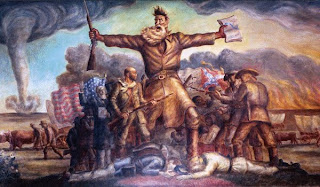
John Brown's body lies a-mouldering in the grave...

Thus begins one of the most influential songs of the 19th-century, sung by Union soldiers marching off to war as "foot-soldiers of the Almighty."

But just who was John Brown?

This week, you'll find out.

Upcoming Assignments

1.) Watch Monterey Institute, Unit 4, Chapter 11, Lesson 34 - "The Approaching War"

a.) "Consider This - John Brown": How did Julia Ward Howe's song with the apocalyptic message influence religious thinking in the North and the South during the Civil War era?

b.) "The United States had been rapidly expanding westward since the Louisiana Purchase. How did American expansion influence a growing sectional crisis after 1820? Did the war with Mexico put the U.S. on an inevitable road toward the Civil War?"

-These two items are due on Wed., 11/30, at the beginning of class.

2.) John Brown - Historical Marker (Due Mon., 12/5)

-John Brown is one of the most polarizing figures in American History...but how should he be remembered? You have been hired by the West Virginia Historical Society to design a historical marker to designate Harpers Ferry as a National Historic Site. Does it show John Brown as a hero and a martyr for the abolitionist cause, or as a deranged lunatic that plunged the nation into a four-year bloody civil war?

Details to be discussed in class.


3.) Zinn, Ch. 9 - on my website. Give yourself enough time...it's very involved.

Due on Mon., 12/5


4.) Ch. 18-19 Study Guides - on my website.

Due Tues., 12/6

Sunday, November 13, 2011

Manifest Destiny, and what to do with all this new land...


This is what Mexico USED to look like, before the Mexican-American War in the 1840s. This war was just one episode, albeit a major one, in America's development into a country that stretched "from sea to shining sea."


This week, we'll take a look at America's growing pains in the 1800s. From an infant nation hugging the eastern seaboard of North America to a voracious teenage country hungry for even more territory, the United States grew exponentially in the mid-19th century. Here's what you'll need to turn in this week:

1.) Watch all Monterey Institute Unit 4, Chapter 11, Lessons 32-33 presentations.

2.) Complete all "Consider This" short-response questions for the above-mentioned Lessons. (Due Thursday, 11/17)

a.) Lesson 32 - John O'Sullivan Editorial
b.) Lesson 32 - The Mexican-American War
c.) Lesson 32 - Walter Colton Diary
d.) Lesson 33 - Henry "Box' Brown
e.) Lesson 33 - THe Ostend Manifesto

3.) Answer the following free-response question as a comment on this blog (this question appeared on the 2000 APUSH exam) by Friday, 11/18:

"Assess the moral arguments and political actions of those OPPOSED to the spread of slavery in the context of TWO of the following:

*Missouri Compromise of 1820
*Mexican-American War
*Compromise of 1850
*Kansas-Nebraska Act"

4.) "American Pageant" Ch. 17 Guidebook - Due Wed., 11/16

5.) Zinn, "A People's History of the U.S." Chapter 8 Questions - Due Wed., 11/16

6.) Read Henry David Thoreau's "Civil Disobedience" (on my webpage); this was Thoreau's treatise on an American citizen's obligation to protest his government's wrongful actions, and an explanation on his willingness to be imprisoned because of his refual to pay a tax in support of the Mexican-American War. As you read it, answer the following questions with well-thought-out responses (Due Fri., 11/18):

a.) Thoreau believes that people should not participate in injustice but that they do not have to actively promote a more just world. What is the difference between these two concepts, and why does Thoreau make this moral distinction?

b.) Is Thoreau's conception of civil disobedience compatible with democratic government? Why or why not?

c.) What is Thoreau's opinion on wealth and consumption? Why does he say that the rich are less likely to practice civil disobedience?

d.) What might Thoreau think about the role of government in today's society (in particular, what might he think about the modern welfare state?)?

e.) Is compromise on moral issues a necessary part of living with other people?

f.) How does Thoreau justify the moral need for civil disobedience? What principles does he rely on in his justification?

g.) Would you describe Thoreau as optimistic or pessimistic about people's ability to improve the world? Explain.


*Though I will not require it over the Thanksgiving break, you may wish to take a "preview" look at the upcoming chapters in "American Pageant" and Monterey Institute's website if you wish to be successful on the next exam. The "American Pageant" guidebooks for Chapters 18-21 are already on my website, and you KNOW what will be required from the Monterey Institute website for the next few chapters. We will move VERY fast after Thanksgiving in order to be through the Civil War by the winter holidays. The workload won't lessen, though...

Monday, October 31, 2011

The Ferment of Reform & Culture, 1790-1860


Yeah, about that...

The picture to your left is nothing new, though. People have been predicting the end times for centuries, and U.S. history is full of such instances. In this next section of APUSH, we will explore the beginnings of the Second Great Awakening in America's young experience and compare it to the first Great Awakening a century before. We will also see how higher-minded people set out to reform this nation in the wake of the religious fervor and cultural shift in the 1830s and 1840s. As you study for your next exam (coming next week over "American Pageant", Chapters 12-16), keep in mind how the reform movement grew in this time period, the role women took in the early American reform movement, and advances in public education and the sciences.

Stuff due soon:

1.) Guiding Questions and Graphic Organizer for "Irish Immigration" classroom lesson on Tues., 11/1.

2.) "American Pageant" Chapter 14 & 15 Guidebooks due by Wed., 11/2.

3.) "American Pageant" Chapter 14 & 15 Short-Response Questions (on my webpage) due on Fri., 11/4.

4.) Monterey Institute Unit 3, Chapter 10 Activities due Monday, 11/7. These include:

A.) Lesson 30: "Transcendentalism" - Consider This: "Do you think it would be possible to be as happy living in Thoreau's cabin as in emerson's elegant house?" Be sure while answering this that you show a basic understanding of transcendentalism.

B.) Lesson 30: "The Second Great Awakening" - Consider This: "Though men such as Charles Finney & Peter cartwright were leaders of religious revivalism i nthe early 19th century, notice the strong presence of women in the revival and camp meeting scenes. What ideas do you think the artists meant to express by giving women so consistently a dominant place of interest?"

C.) Lesson 30: "Millerites" - Consider This: "End-of-the-world predictions play on human anxieties and are a regular feature of history, especially at the turns of centuries. How do the preparations of the man depicted in this cartoon compare with those that many people made at the turn of the millenium in expectation of a Y2K disaster?"

D.) Lesson 30: "Alternative Communities" - Consider This: "Communal groups can be very efficient and productive when sincere and like-minded adherents are led by powerful idealists, as in the Shaker and Mormon communities. Why do you think such groups either faded away or altered their system to a more mainstream standard after a relatively short length of time?"

E.) Lesson 31: "David Walker's Appeal" - Consider This: "Did the actions of abolition extremists, like David Walker, help or hurt the antislavery crusade?" Be sure to include several pieces of evidence to back up your opinion.

F.) Chapter 10 Writing Assignment: "Great Awakening/Second Great Awakening" Comparison (be sure to use the Graphic Organizer in compiling evidence to form a coherent thesis AND write an essay).

G.) Chapter 10 Discussion Question: "How did the Second Great Awakening influence the reform movements of the nineteenth century? How did these reform movements socially re-shape the United States and allow for growing sectionalism?"

-Monterey Institute Assignments for Unit 3, Chapter 10, are due by Tues., 11/8.

Wednesday, October 12, 2011

Andrew Jackson & The Rise of Mass Democracy


Look at the picture to the side: what does it represent to you?

This is a depiction of newly-elected President Andrew "Old Hickory" Jackson's inaugural party at the White House in 1829. The nation's capital had never seen such an event: thousands of people gathered in Washington, DC, to celebrate Andy's victory because, after all, they had received an invitation from the "People's Champion" himself! Most of them finally converged at the White House, compelling Jackson to sneak out the back door while his constituency offended their fellow more elitist party-goers, broke (or stole) the White House china and silverware, and consumed vast amounts of celebratory cider and punch. It was obvious to all observors that politics, and America itself, had changed...if not for the better, than at least for good. After all, as Jackson's detractors would sneer, would you ever see President Washington or John Adams presiding over such a scene?

For the next several days, we're going to take a look at how American politics changed as a result of the War of 1812 (otherwise known as the Second War for American Independence) and the rise of the Jacksonians. Also key to this study will be the impact of the United States' early westward expansion on the native Americans that lived on the American frontier. Your assignments for the next several days will be:

1.) Watch the presentations for Monterey Institute, Unit 3, Ch. 7-8, Lessons 20-22

a.) Lesson 20 - "The Louisiana Purchase" - Consider This - Were President Jefferson's responses to the Barbary pirates and the opportunity to buy the Louisiana Territory in harmony or conflict with his philosophy of Jeffersonian democracy?
b.) Lesson 20 - "The Aaron Burr Conspiracy" - Consider This - How did Aaron Burr's fateful duel with Alexander Hamilton affect political strategies of the early 1800s? What did Burr lose and/or gain politically?
c.) Lesson 21 - "Jefferson's Embargo" - Consider This - How did the Embargo & Non-Intercourse Acts support or challenge President Jefferson's political beliefs?

-These questions and answers are due on Mon., 10/17.

2.) Watch the presentations for Monterey Institute, Unit 3, Chapter 9, Lessons 26-29

a.) Lesson 26 - "The Election of 1828" - Consider This - The states of Virginia and Maryland were the last to adopt universal manhood suffrage. What characteristics do you think caused them to wait?
b.) Lesson 27 - "The Tariff of 1828" - Consider This - What other actions did President Jackson take that his opponents considered were outside of the authority of the presidency?
c.) Lesson 28 - "19th Century Banking" - Consider This - If the charter for the 2nd Bank of the United States had been renewed, how do you think it would have influenced the development of the West?
d.) Lesson 29 - "The Indian Removal Act" - Consider This - If Jackson had NOT been successful in carrying out his plan of Indian Removal, do you think the eastern states would have remained ethnically multiracial instead of biracial? What implications might that have had during the Civil War era?

-These questions and answers are due on Tues., 10/18.

3.) "American Pageant" Guidebooks, Ch. 12-13 - Due by Wed., 10/19

4.) "American Pageant", Ch. 12-13 Short-Response Questions (on my McKeel webpage) - don't wait until the last minute!! There are 48...

-Due Thurs., 10/20

4.) Zinn's "People's History", Ch. 7 - "As Long As the Grass Grows and the Water Runs"

a.) In 3-to-5 paragraphs, briefly summarize the chapter. Be sure to include the following words/terms, and highlight where you use them: Indian Removal, Tecumseh, Andrew Jackson, Creeks, Cherokee, Sam Worcester, Assimilation
b.) Answer the following:
1.) Explain why the United States treated natives in the manner they did. (3 to 5 paragraphs)
2.) Is there any parallel between Bacon’s Rebellion and the Indian wars preceding the War of 1812, with respect to the dynamics among the Indians, poor whites, and rich whites? If so, explain how the situations are parallel. If not, what factors are different enough so that there is no structural parallel? (3 to 4 paragraphs)

-Due Friday, 10/21

Sunday, September 25, 2011

The Constitution

What makes the United States special? Is it our diversity? Our determination? Our natural resources? Or is it our system of government, a system of checks and balances on the most powerful governing parts, set up in a way as to not allow any one part more obvious power over the other two? A system that is run, for all intents and purposes, by the voices of those that it governs?

This week, we will take a closer look at this system and its formation in the late 1700s, a decade after independence from Britain was won. You are responsible for the following assignments.

[Please remember, at this point, you are full-fledged APUSH students, so this will now be run more like a college class; in other words, no more late assignments will be accepted. Assignments are due during 2nd period on the due dates unless otherwise noted. If you have a question or concern about this policy, see me during my office hours (8:30-9:20AM daily, or afternoons by appointment).]


1.)“American Pageant” Guidebooks, Ch. 9 & 10 – Due Tues., 9/27

2.)Document-Based Question :“How Revolutionary Was the Revolutionary War?” – Due Wed., 9/28

3.)Precis for Zinn, Ch. 5 – Due Thursday, 9/29

4.)Monterey Institute, Unit 2 – Chapter 5 (Lessons 14 & 15) – Due Fri., 9/30
a.)Lesson 14 – “Explore the Articles of Confederation” – Mult. Choice
b.)Lesson 14 – “Explore the Virginia Statute of Religious Freedom, 1786” – Answer the “Consider This” question
c.)Lesson 15 – “Explore ‘A Supernumerary Crisis’ by Thomas Paine” – Mult. Choice
d.)Lesson 15 – “Explore the Land Ordinance of 1785” – Mult. Choice
e.)Lesson 15 – “Explore the Northwest Ordinance of 1787” – Mult. Choice
f.)Lesson 15 – “Explore Letters to James Madison” – Answer the “Consider This” question

5.)“The Framers and the Faithful” article from “Washington Monthly”, April 2006 – Read the article, and answer the questions included (BOTH documents are on my McKeel webpage) – Due Mon., 10/3

6.)Zinn, Ch. 6 – “The Intimately Oppressed” (Questions on my webpage) – Due Tues., 10/4

7.)Monterey Institute, Unit 2, Chapter 6 (Lessons 16 thru 19) – Due Thurs., 10/6
a.)Chapter 6 – Free-Response Question (“Evaluate the extent to which the Articles of Confederation were effective in solving the problems that confronted the new nation?”
b.)Chapter 6 Writing Assignment (“Patrick Henry’s objection”)
c.)Chapter 6 Discussion Question (“How did the compromises made when writing and ratifying the Constitution encourage the development of political factions? Compare and Contrast the effectiveness of Washington’s and Adams’ presidencies in obeying and promoting the Constitution during their administrations.”)
d.)Lesson 16 – “Explore Congress Hall, Philadelphia” – Answer the “Consider This” question
e.)Lesson 17 – “Explore Federalist & Anti-Federalist Papers on Taxation Power” – Mult. Choice
f.)Lesson 17 – “Explore Washington’s First Inaugural Address” – Mult. Choice
g.)Lesson 17 – “Explore Bill of Rights” – Mult. Choice
h.)Lesson 18 – “Explore George Washington’s Proclamation of Neutrality” – Mult. Choice
i.)Lesson 18 – “Explore the Jay Treaty” – Mult. Choice
j.)Lesson 18 – “Explore Washington’s Farewell Address” – Mult. Choice
k.)Lesson 19 – “Explore Virginia & Kentucky Resolutions” – Mult. Choice

Besides these assignments, you will also have classwork assignments that will be turned in as well.

Wednesday, September 7, 2011

Founding Fathers, or Revolutionary Outlaws?


So, just what exactly is this thing called "HISTORY"?

-It's an account of the past.
-The accounts/narratives differ depending on one’s perspective.
-As historians, we rely on evidence to construct our accounts of the past.

-Any single piece of evidence is insufficient...therefore, we must consult multiple pieces of evidence in order to build a plausible account.

What would you say about a person that formed an opinion about a topic after only viewing one source of information? Can you then build an historical account based on only one side of the story?

Take the Founding Fathers, for instance. They risked EVERYTHING they had earned and/or inherited, legally and illegally, to form a more perfect union out of 13 English colonies hugging the eastern seaboard of the North American continent (if you want to know what sort of danger the Founders were in during the struggle, check out the account in "American Pageant" of how King George III dealt with a few Irish rebels at the same time). But why? Out of a sense of duty to create something better for posterity? Because Parliament and King George III taxed them too heavily? Are there other reasons?

We all know how the American Revolution ended...and we all know that the winners write history. Have you ever checked out the English side of the story, though?


http://www.redcoat.me.uk/Rev-War.htm

I think you'll agree that there account of the facts is a little bit different than ours.

Here is a list of what's coming up:

1.) "American Pageant," Ch. 8 Guidebook - due by Mon., 9/12

2.) "Loyalists" - some colonists remained loyal to England during the fight for independence (like colonists in East & West Florida, the 14th & 15th colonies that never get mentioned). Why? At what cost? On my McKeel webpage, there are a series of primary documents in .PDF format titled "Loyalists"; read the accounts and complete the graphic organizer attached. Then answer in paragraph-form the following (using your knowledge of the topic):

• Why did some colonists oppose independence?
• Do their arguments seem reasonable?
• What might Patriots have said in response to these arguments?
• Which side do you think was more reasonable?

*This "Loyalists" assignment is due on Tues., 9/13.

3.) You will need to view the following lessons (and complete the activities) on the Monterey Institute's AP US History I website () http://www.montereyinstitute.org/courses/AP%20US%20History%20I/nroc%20prototype%20files/coursestartc.html:

A.) Watch Unit 2, Chapter 4, Lessons 10 ("Imperial Reorganization") & 11 ("Philosophy of the American Revolution")
B.) Complete the Writing Assignment for Chapter 4 ("Reasons Many Americans Felt Pushed Toward Independence" - one-to-two paragraph response.
C.) Complete the Discussion Question (as a response to this blog or on paper) for Chapter 4 - "Why did the British change their economic and political policies towards the colonists from 1763 to 1775? Were the colonists justified in their response to the British policies? What groups were the colonists defending/neglecting in their revolt against the British?"

D.) Watch Unit 2, Chapter 5, Lessons 12 ("The Declaration of Independence") & 13 ("The Revolutionary War")
E.) Complete the Writing Assignment for Chapter 5 ("5 Grievances in the Declaration of Independence")

Assignments A-E from the Monterey Institute's APUSH website are due by Wed., 9/14.

Sunday, August 28, 2011

Welcome to the APUSH Blog!!

APUSH Gang,

If you're reading this, you've found my blog...congratulations! This is where you can expect to find your weekly assignments, nuggets of my wisdom, and just generally cool stuff.

This week (Aug. 29th-September 2nd), we are going to take a quick look at Britain's North American colonies prior to the American Revolution. Here's what you can expect:

1.) "American Pageant" Guidebooks, Ch. 6-8, are on my McKeel webpage and ready to be downloaded and completed. You should complete Ch. 6 & 7 this week...email your findings to me by Fri., 9/2. Start working on the Ch. 8 Guidebook over the Labor Day weekend, since you won't have anything better to do. Hee hee...

2.) You need to go to the Monterey Institute's APUSH online course (there is a link to it on my McKeel webpage) and complete the assignments for Unit 1, Chapter 3, Lesson 7-9. Here's how it works:

Lesson 7 – “Colonial Life”-View the presentation titled “Colonial Life” (Watch the entire presentation)

Topic 1 – “Origins of Slavery”

a.) Explore “Slave Ships” – click on the link to view the illustration, then answer the accompanying question
b.) Explore “The Virginia Slave Codes” – click on the link to read the Slave Codes, then answer the “Consider This” question
c.) Explore “Olaudah Equiano: A Slave Experience” – click on the link to read Equiano’s account of his experience aboard a slave ship. Then, read the five excerpts from Equiano's autobiography that were given to you in class on 8/30...

As you read all five excerpts, highlight evidence that shows the emotions and physical senses that Equiano felt during his journey across the Atlantic. Then, look up what happened on the slave ship named Zong. Due Tues., 9/6.

Topic 2 – “Diversity”

a.) Explore “Regional Imports and Exports” – click on the link to view the illustration, then answer the accompanying question

Topic 3 – “Family and Social Life”

a.) Explore the “Charter of Rhode Island and Providence Plantations, 1663” – click on the link and answer the multiple-choice question

-Follow this same routine/list of assignments for Lesson 8 (“Scientific and Religious Transformations”) & Lesson 9 (“The French & Indian War”). These are due on Friday, 9/2.

3.) Answer the following Free-Response question from the 2001 APUSH end-of-the-year exam: “How did economic, geographic, and social factors encourage the growth of slavery as an important part of the economy of the southern colonies from 1607 to 1775?” You may turn this in as a Word document, handwrite your answer, or email your response to me by Thursday, 9/1.

4.) On the Monterey Institute's website, when you click on Unit 1, Chapter 3, the menu that appears to the right side of your screen includes the following: "Writing Assignment Chapter 3 – American Society Takes Shape”

-Read the two documents, then answer the questions at the end of the exercise. This is due by Wed., 8/31

5.) Answer the following question as a response on this blog. It should be well-thought-out and planned, and should contain at least 300 words. This should be posted on my blog by Thurs., 9/1.

Question - "How did the economic system of the British North American colonies affect the lives of those who lived there? Did it create different groups of 'winners' and 'losers'?"

6.) Be prepared to write your first DBQ of the year this week. It will be a comparison of the Chesapeake and New England colonies. We will go over the documents in class, but you will write the essay on your own time.

7.) This week, you will need to read Chapter 3 of Dr. Zinn's "A People's History of the United States." This chapter is entitled "Persons of Mean & Vile Condition." As you read, write a one-page precis; when you finish the chapter, answer the following:

a.) Why does Zinn choose this title for chapter 3?
b.) Do you agree with his thesis in this chapter? (for this question, it would help if you identify the thesis first) Why or why not?
c.) What would be a good alternative title for this chapter? Why did you choose this?
d.) In light of the primary documents that we viewed in class on Tues., 8/30 (in defense of indentured servitude in the Chesapeake region, and the court proceeding in Virginia in 1640), and in the context of 17th-century strife between landowning elites and their former servants, why did slavery become the better option to the labor question in Virginia and Maryland, and later throughout the South? What does Zinn say about this question?

This Zinn assignment is due on Tues., 9/6.

8.) The APUSH test at the end of the year is scheduled for 8AM, Friday, May 11, 2012. Unfortunately, the same day is a McKeel holiday for staff and students. You will be expected to be here for the exam; administration will open the school for us, and we will be finished by noon. Please let your parents know, even though a letter will be sent home in the next few days.

Tuesday, April 12, 2011

The Early Days of the Cold War - The Truman Years


APUSH Gang,

Just because it's FCAT Week doesn't mean that we have nothing to do! The APUSH exam is right around the corner, and we need to prepare ourselves. This week, we will take an intensive look at the early years of the Cold War, when Europe and Japan were in ruins, there were only two superpowers that stood ready to stand in each others' way, and the United States had a difficult choice to make: retreat to isolationism again, or recognize the potential threat to world domination that the Soviet Union had become.

"American Pageant" Ch. 36 Guidebook ("The Cold War Begins, 1945-1952") is on my McKeel webpage. You will also find answer keys for Ch. 29-35. There is a LOT of information to learn about the early years of the Cold War that may rear its head on the APUSH exam in a few weeks, so be prepared to know how to answer Ch. 36 Guidebook's ten "PART III: APPLYING WHAT YOU HAVE LEARNED" essays.

You will have an exam on Fri., 4/15, on Chapters 29-33 (Wilsonian Progressivism, WWI, the Roaring Twenties, the Great Depression, & the New Deal). This was posted on my blog last week, but I thought that WWII would be adding a little bit too much. You will report for this exam in Mrs. Fields' room after Advisory, and you may take up to 60 minutes to complete it. Bring #2 pencils!!

As for your assignments for "The Cold War, 1945-1952":

1.) You will need to get two videos from me: "America in the 20th Century: The Post-War Years" and "America in the 20th Century: The Cold War". You can stop the 2nd one after the segment on the Korean War ending with an armistice in 1953 after Gen. MacArthur is relieved of his command. Your assignment for both is to write an outline for both films, segment by segment. Each one should contain at least 25 fully-written points of interest. - Due Tues., April 19

2.) There is a DBQ from the 2006 APUSH exam on my website. Look at it, analyze the documents, and write it (only Section II, Part A). Remember, no matter how well-written it might be, if it contains no outside information, it will not score better than a 4 out of 9, so be sure to digest Ch. 36 in "American Pageant", watch the films, and plug through the Monterey Institute's offerings on the Cold War (listed below...Due Wed., April 20

3.) "American Pageant," Ch. 36 Guidebook - Due Thursday, April 21

4.) Monterey Institute's Unit 9, Chapter 22 ("HST & IKE"), Lessons 65-68

http://www.montereyinstitute.org/courses/AP%20US%20History%20II/nroc%20prototype%20files/coursestartc.html

a.) Key Terms - For each term, note the definition as well as the term's significance (Due Mon., 4/18)
b.) Writing Assignment - This is a free-response question from the 2002 APUSH exam. MAKE SURE YOU GO TO PAGE 8 & ANSWER ONLY #4. (Due Tues., 4/19)
c.) Discussion Question - Answer the following question as a response to this blog: "How did the U.S. policy of containment affect the decision-making of the government during the 1940s and 1950s? Did Americans overreact to the potential threat of communistic influence in the U.S.?" Your response should be at least 350 words, and should be posted by Thursday, 4/21.

KEY CONCEPTS

1. Explain the causes and consequences of the post–World War II economic boom.
2. Describe the large postwar migrations to the Sunbelt and the suburbs.
3. Explain changes in American society and culture brought about by the "baby boom".
4. Explain the origin and causes of the emerging conflict between the United States and the Soviet Union after Germany’s defeat and Truman’s accession to the presidency.
5. Describe the early U.S.-Soviet Cold War conflicts over Germany and Eastern Europe, and explain why the United Nations proved largely ineffectual in addressing them.
6. Discuss the American theory and practice of containment, as reflected in the Truman Doctrine, the Marshall Plan, and NATO.
7. Describe the concern about Soviet spying and communist subversion within the United States and the increasing climate of fear it engendered.
8. Describe the expansion of the Cold War to East Asia, including the Chinese communist revolution and the Korean War.
9. Other important stuff: the Warsaw Pact, the Berlin Airlift, Communist insurgencies in Greece & Turkey in 1947-1948

Sunday, April 3, 2011

"The Good Fight"...America in World War II


APUSH Gang,

This week is probably my favorite week in the curricular calendar: World War II week!! Good vs. Evil, with the forces of liberty and democracy fighting to save the world from tyranny and oppression...but it's never quite THAT easy, is it? If it was, why would we have a picture like the one you see shown on this post?

With the APUSH Exam fast approaching, you will be working VERY hard this week to learn as much as you can about America's shining moment, when our grandfathers and great-grandfathers, freshly recovered from the privations of the Great Depression, fought a two-front war in Europe and the Pacific.

This Week's Due Dates/Assignments:

1.) "American Pageant," Chapters 34-35 are on my website to print and use...and the Answer Key to Ch. 29-33 is there, too...you're welcome.

2.) Zinn, Ch. 16 Questions ("A People's War?") - Two sets of questions this time, since: 1.) I won't see you next week until Fri., 4/15, and; 2.) there is a lot of good early Cold War stuff in this chapter, too, which you will be learning about next week on your own. These questions can be given to me by Wed., April 13.

3.) The Monterey Institute's interactive unit for WWII can be found at:

http://www.montereyinstitute.org/courses/AP%20US%20History%20II/nroc%20prototype%20files/coursestartc.html

This is great stuff, and we'll see some of it in class on Mon., 4/4. Here are the assignments for this interactive site (you'll need to use the resources on this website and other sources, too):

a.) Define the Key Terms (due Wed., 4/6)
b.) Answer the Writing Assignment question using the 4 documents included on the website AND our class activity on Thurs., 4/7 (due Fri., 4/8)
c.) Answer this question as a response on this blog by Fri., 4/8 - "While 15 million Americans were called overseas to fight the Axis aggression, Americans at home faced tremendous changes during wartime as well. How did Americans respond to the call of war domestically?" This should be at least 400 words (include your word count).

4.) WWII Propaganda Posters - you will need a Notes Sheet (matrix format) and a form titled "Common Objectives and Rules of Propaganda." The posters themselves are on my website. This assignment is due by Tues., April 12.

5.) You may choose ONE of the following two options to explore: a.) German POW Camps in Florida during WWII, or; b.) "Operation Drumbeat," a Nazi terrorist plot to sabotage America's infrastructure during WWII. These assignments are due by Wed., April 13.

6.) I have two videos and supplemental activities to be viewed, completed, and turned in by Fri., April 15. If you are interested in earning twenty points extra credit, you may want to download these films and complete this assignment (due Thurs., April 14).

-You can expect an exam on Chapters 29-35 in "American Pageant" on Fri., 4/15. It will be heavy on the Great Depression, the New Deal, & World War II.

Sunday, March 27, 2011

The Great Depression & FDR's "New Deal"


APUSH Gang,

The date for the AP US History exam is fast approaching, and a LOT of topics that could be seen on the test are about to become more familiar to all of you, starting with the Great Depression and the New Deal of the 1930s.

Something that you will all want to do as soon as possible is bring a memory stick to class so that you can watch United Streaming's "America in the 20th Century: The Great Depression." This is a great half-hour-long summary of the 1930s in the United States; I will also allow you to use some practice materials to become more proficient in your knowledge of this formative era in American history, which may also be saved to your memory sticks.

You will also want to visit my McKeel Academy webpage and save the Guidebooks for Chapters 32-33. These are important to study for these two chapters. I expect these to be finished by Friday, April 1st, including essay questions.

You will also need to read Ch. 15 in Zinn's "A People's History of the United States." On Mon., 3/28, I will assign you the usual questions in class (make sure you get it from me!), but this week, you will go the extra mile: there is also a Zinn Ch. 15 study guide on my McKeel Academy webpage. Complete this document as well and email it to me (due dates to follow).

This week, we will be using a new resource to study the Great Depression. It is a multimedia unit of study that can be found at:

http://www.montereyinstitute.org/courses/AP%20US%20History%20II/nroc%20prototype%20files/coursestartc.html

You will select Chapter 20 from the Table of Contents. You are required to view Lessons 59 & 60 ("Causes & Consequences of the Great Depression" and "The New Deal"), including all readings, presentations, and anything under the "Explore" tab for each lesson. In addition, under the "Assignments" tab in the Table of Contents for Chapter 20, be familiar with all key terms, complete the map activity on the Dust Bowl, answer the DBQ ("Analyze the responses of FDR's administration to the problems of the Great Depression. How effective were these responses, and how did they change the role of the federal government?"), and complete the writing assignment.

Now, for due dates. Obviously, you already have the "Florida Terror" and "Scopes Monkey Trial" assignments due on Tues., 3/29. Here are this week's assignments due dates:

-Tues., 3/29: "Florida Terror" & "Scopes Monkey Trial"
-Wed., 3/30: Key Terms from the Monterey Institute's online unit & the map activity
Thurs., 3/31: Zinn Ch. 15 Study Guide & questions (#1-#27), Monterey Institute writing assignment ("Rank the causes of the Great Depression, and then write a 300-word essay on the following: identify three points at which intervention by the federal government could have slowed or perhaps even stopped the Depression.")
Fri., 4/1: Have "American Pageant" Guidebooks for Chapters 32-33 completed.
Mon., 4/4: DBQ about the New Deal (this is the ACTUAL AP Exam DBQ from the 2003 exam!)

Now, a few of you have been asking about extra-credit. Here is your opportunity:

1.) For fifteen extra points, post your response to this question on this blog by Fri., 4/1: "How did the philosophy of government change in America during the 1930s as a result of FDR's New Deal?" This should be at least 200 words, and you should use specific examples from this week's learning.

2.) For ten extra points, complete the "Great Depression" flm's video quiz true-false & multiple-choice questions. Correctness will count! For five extra points each, complete the other assignments included in the .pdf file. This can be turned in on Mon., 4/4.

As always, no extra-credit will be accepted from any student that does not turn in ALL required assignments.

Monday, January 31, 2011

The Great American West


It's "Cowboys and Indians" time, APUSH Gang! Yee-haw! This week, we will look at the time after the Civil War when the United States government made a concerted effort to push west to the Pacific, eventually displacing thousands of natives along the way in the name of economic prosperity and civilization.

On my McKeel website, you will find the five documents that make up "This Land Is Ours" from the "A Place at the Table: Struggles for Equality in America" curriculum from the Southern Poverty Law Center. This episode details the story of the Ponca tribe of Nebraska, who were threatened with expulsion from their ancestral home in the 1870s. As you read their story, answer the following questions on a Microsoft Word document and submit them to me by Friday, February 4th:

“This Land Is Ours” – Chapter 4 from “A Place at the Table: Struggles for Equality in America”

1.) What factors contributed to the U.S. government’s policy of forcibly removing Native Americans from their ancestral lands?

2.) Explain the title of this story – “This Land Is Ours.”
a.) What are some other possible interpretations?
b.) Do you see a possible irony in the title? If so, explain what it is.

3.) How did the legal principle of habeas corpus advance the cause of the Ponca? What arguments did the government use against it?

4.) How much did you know about the story of Chief Standing Bear and the Ponca before you read “This Land Is Ours”?
a.) What reasons can you give for your answer?
b.) What do you know about the other Native American chiefs and leaders mentioned in the story?

5.) How has our society’s understanding of the phrase “all men are created equal” changed since it was first written in the Declaration of Independence?
a.) How does the Ponca’s story contribute to that understanding?
b.) Are there limits to our understanding of the phrase today? Explain.

Also, we will be looking at a DBQ on the Old West this week in class. All DBQ essays are due on Tuesday, February 8th.

Tuesday, January 18, 2011

Industrialization & Immigration

After the Civil War, the United States began to finally flex its economic muscles and become a world leader in industry. With the economy booming, opportunities arose for people from all over the world to come make their own destinies in the New World. And over 43 million did...

Captains of industry, robber barons, the nouveau riche, immigrant workers, child laborers...all played a vital role in this next chapter of American History.

Assignments (1/18-1/28):
1.) "A People's History of the United States" - Ch. 11 Questions ("Robber Barons & Rebels"), due Tues., 1/25

2.) DBQ - choose "Captains of Industry" or "The New Immigrants", due Wed., 1/26

3.) Ch. 24 & Ch. 25 Guidebooks, due Fri., 1/28

4.) Exam on Ch. 24 & Ch. 25, Fri., 1/28

Monday, January 3, 2011

Reconstruction, 1865-1877


After the Civil War, the United States government began the long & arduous process of Reconstruction. The next dozen years saw former slaves reach new heights socially, economically, and politically, but not without resistance among white Southerners. Then, upon the inauguration of new President Rutherford B. Hayes in March 1877, Reconstruction abruptly ended. Was the work the federal government began to remake the South truly finished, or was the end premature?

There is a wealth of information to learn about Reconstruction, and not much class time to do it in. It is truly a fascinating topic, one that I think helps to explain race relations regional differences still alive today in the United States. And yet, it is such a little known topic.

The following are due dates that you have in APUSH for the next two weeks. Manage your time wisely, because this is a lot.

1.) "American Pageant" Guidebooks for Ch. 20-23 due on Fri., Jan. 14th.

2.) Zinn Questions for Ch. 10 ("The Other Civil War") will be handed out in class, due on Wed., 1/12.

3.) Ch. 22 Discussion Questions will be answered and turned into my Google Docs account (save as "Private," share it with me) by Monday, 1/10.

4.) Read the article saved on my McKeel website ("The American Civil War,
Emancipation, and Reconstruction on the World Stage," by Edward L. Ayers) and write a precis', minimum 500 words, posted on this blog. This is due by Fri., 1/7.

5.) DBQ - "Who Killed Reconstruction: North or South?" (documents analyzed in class on Thurs. & Fri., 1/6-1/7), will be submitted to me on Google Docs by Thurs., 1/13.

6.) Ch. 20-23 Exam on Fri., 1/14.

Monday, October 4, 2010

Do you KNOW the Constitution?

Take a look at this question, and answer fully on this blog. Feel free to respond to your classmates' answers as well. Here goes:

"Some historians contend that the Constitution, by providing the structure of government and powers necessary to perpetuate a strong union, 'saved' the fledgling American Republic from collapse and ruin under the Articles of Confederation. Evaluate this argument utilizing your knowledge of the problems of the United States in the 1780’s."

Post your answer by Fri. evening, 10/8, please. Can't wait to see this!!

Knowledge is power...

Monday, September 27, 2010

Time to know the Constitution....

APUSH Gang,

We're going to be studying and analyzing the Constitution this week, and one thing that is important when analyzing a topic as all-encompassing and relevant as the supreme law of this land is this: what can you do with it?

First, read and explore this website: www.usconstitution.net/constquick.html. This is a quick summary of the Constitution, what the different articles say, and all of the amendments that have been made to it. Pay particular attention to what the authors of this website have to say about religion...just click on the hyperlink in the section for the 1st Amendment.

Next, read the article found at this website:

http://blog.beliefnet.com/flunkingsainthood/2010/09/before-you-attend-jon-stewarts-rally-read-this-from-james-calvin-davis.html?source=NEWSLETTER&nlsource=11&ppc=&utm_campaign=Bible&utm_source=NL&utm_medium=newsletter&utm_term=yahoo.com

Now, answer these question (a blog comment is fine): 1.) "Do you agree, or disagree, that the traits of civility and tolerance are needed in the post-9/11 world, or did 9/11 change that?" 2.) "What do you think the Founding Fathers would say about today's Ground Zero mosque controversy and potential Quran burnings?"


After you've done that, make sure you listen to the podcast at this link: http://college.cengage.com/history/lecturepoints/part01_lecture07/part01_lecture07.html

Wednesday, August 11, 2010

Welcome to APUSH!! Now, get busy...


Hi, APUSH gang! I hope you've had a restful and (mostly) uneventful summer. A few of you have emailed with questions and concerns, and I WOULD apologize for not getting back to you in a timely fashion, but here's the deal: you need to learn to start answering your OWN questions. Sure, I could tell you what to do, what I want...but I'm much more interested in seeing what y'all come up with on your own, or collaborating together.

Obviously, you have some assignments due in the next week: 1.) Your book review on "Lies My Teacher Told Me" by James Loewen; 2.) Your discussion questions and precis for the first three chapters of Howard Zinn's "A People's History of the United States;" 3.) the assignments for the first five chapters of Digital History's online textbook, and; 4.) the 11th-12th grade US Constitution assignment. I know, that's a lot.

Something else I want you to take a look at before we convene on August 19th is the following current event: the proposed construction of a mosque near Ground Zero in New York City. You guys are pretty smart (I hear), and this is a tremendous opportunity for you to amaze me with your knowledge of current events, your ability to argue a point, and the strength of your convictions. On this blog, reply with your well-reasoned answer to this question: "Should a group of Muslims be allowed to build a mosque and Isalmic Cultural Center near the site of Ground Zero in New York City? If no, with what authority can the construction be stopped and how? If yes, under what authority should it be allowed?"

Have fun! Play nice...

Wednesday, March 17, 2010

The Roaring Twenties


APUSH students:

This week we'll be analyzing the myths and the realities of the Roaring Twenties. Your Ch. 31 & Ch. 32 Study Guides are due by Mon., 3/22. Your DBQ on the 1920s is due by Wed., 3/24 (I'll need something to read on the plane to San Diego on 3/25!!).
The end of the 3rd quarter is upon us. Make sure you complete these assignments, plus keep up with all readings and exam preparation.